Aconitum Napellus in Homeopathy – Uses, Benefits, Potencies & Side Effects


Few homeopathic remedies announce themselves as clearly as *Aconitum napellus*. Picture this: a person — adult or child — perfectly well an hour ago, now burning with fever, unable to sit still, tossing and turning, heart racing, face twisted in fear. Ask what is wrong, and they may say it in so many words: “I feel like I’m dying.” That sentence is the Aconite keynote.
Sudden, violent onset. Fear that borders on terror. A body and mind in full alarm. Aconite is the remedy of the first hour — the first stage of a cold or flu, the first spike of a fever, the first wave of a panic attack, the immediate aftermath of a fright or shock. It is the medicine for the moment when everything happens at once. In this guide we cover what *Aconitum napellus* is, the complete Aconite picture, how to use it for fever, colds, panic, and neuralgic pain, which potencies to choose, and when it is time to put the remedy down and reach for something else.
What Is Aconitum Napellus?
*Aconitum napellus* — commonly known as Aconite, Monkshood, or Wolfsbane — is one of the most powerful and fast-acting remedies in the homeopathic materia medica. The plant, of the family *Ranunculaceae*, grows across Europe and Asia in damp, mountainous meadows, its tall spikes of blue-violet hooded flowers unmistakable. Its homeopathic use dates back to Samuel Hahnemann’s proving in the early nineteenth century, which mapped out the remedy’s picture of sudden illness and overwhelming fear.
In its raw botanical form, *Aconitum napellus* is among the most toxic plants in the Western world. Every part of the plant contains aconitine, a potent alkaloid poison. Yet homeopathic pharmacy transforms this dangerous plant through potentization — serial dilution with vigorous succussion — into a preparation safe for all ages, from newborns to the elderly, while retaining the remedy’s healing action. This is the paradox at the heart of homeopathy: the same substance that can kill becomes, in infinitesimal dose, a gentle and profoundly curative medicine.
Get this at the best price on Amazon
Prices on Amazon change daily — right now this pick is at one of its best prices, with free fast Prime shipping and easy 30-day returns. Check the current price before you buy.
Buy From Amazon As an Amazon Associate I earn from qualifying purchases.Homeopaths call Aconite the “Remedy of the First Hour” — it works best at the very onset of illness, before symptoms have settled and progressed. Speed and suddenness are its hallmarks, and so is the fear that rides along with them. Miss the early window and another remedy is usually needed — which is why knowing the Aconite picture matters.
The Sudden-Onset Picture
The classic Aconite state is one of acute, sudden, violent invasion. There is no slow build-up, no gradual drift. Symptoms explode into being, often within an hour or two of a triggering event, and the patient is thrown into intense physical and mental agitation.
The essential Aconite features, as described across the homeopathic literature:
- Suddenness — fever, fear, or pain that comes on rapidly, sometimes “like a bolt from the blue”
- Restlessness — the patient cannot keep still; they toss, turn, pace, and change position constantly
- Anxiety of mind and body — mental dread combined with physical agitation
- Fear of death — the patient genuinely believes they are dying and may even predict the hour of their death
- Dry, burning heat — the skin is hot and dry in the early stage of fever, before sweating begins
- Thirst for cold water — a consistent physical keynote
- Palpitations — a rapid, pounding, visible heartbeat that accompanies the anxiety
- Midnight aggravation — symptoms are frequently worse around midnight, often waking the patient from sleep
The fear is not vague worry but concrete, overwhelming terror — the conviction that death is imminent. This is what distinguishes Aconite from every other remedy, and why it is so valuable in genuine emergencies, where the emotional state matches the physical storm.
Aconite for Fever & First-Stage Cold
Aconite is the number one homeopathic remedy for fevers that come on suddenly, particularly after exposure to cold, dry wind or a sudden chill. The fever rises rapidly, sometimes within hours. The classic picture:
- Fever that begins within hours of cold exposure
- Burning, dry heat of the skin, with no sweating in the early stage
- Great thirst for cold water
- Extreme restlessness and anxiety alongside the fever
- The patient may say they feel they are going to die
- Worse at night, especially around midnight
The golden rule: give Aconite early. It is at its most powerful in the first hours, before the process has settled. If sweating has already begun, if the fever has lasted more than 24 hours, or if the discharge has turned thick and yellow, Aconite is no longer the best match — see “When It Stops Fitting” below.
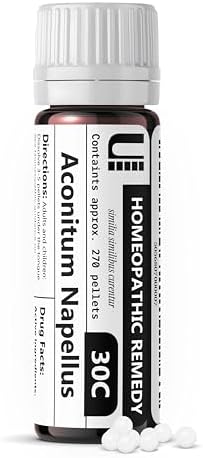
Aconitum Napellus 30C Pellets on Amazon
Case example: sudden fever after a day in the wind. Maya, six, spent the afternoon at a windy outdoor market. By 9 p.m. she was flushed and burning hot; by 10 p.m. the thermometer read 39.8°C (103.6°F). She refused to be put down, thrashed in her mother’s arms, and kept whimpering, “I’m going to die.” Her skin was dry and hot; she begged for cold water and drank greedily. Her mother gave *Aconitum napellus* 30C — two pellets dissolved in a little water, sipped slowly. Within twenty minutes Maya stopped thrashing and asked for a story; an hour later the fever had begun to break and she slept. Two further doses at longer intervals saw her through the night. The next morning she woke hungry and well.
Aconite for Anxiety & Panic
Aconite is one of homeopathy’s premier remedies for acute anxiety and panic attacks. The emotional state is unmistakable:
- Sudden, overwhelming terror that comes out of nowhere
- An intense, irrational fear of death — the patient may predict the exact time they will die
- Extreme restlessness — cannot sit or lie still, must move constantly
- Heart palpitations with anxiety — the heart pounds, races, and seems to “jump out of the chest”
- A feeling of suffocation or tightness in the chest
Aconite suits panic that arises from a specific frightening event rather than free-floating worry. The classic scenario: a person is in a car accident, receives shocking news, or undergoes a frightening procedure, and within hours is plunged into a state of terror, convinced they are dying, unable to settle, with a pounding heart — so physical that they fear a heart attack.
Aconite also covers anticipatory fear — dread before surgery, a dental appointment, an exam, or a journey — intense enough to produce physical agitation, palpitations, and that signature fear of something terrible. For functional, anxiety-driven palpitations, Aconite is frequently the first remedy considered: rapid, strong heartbeat after a fright, chest tightness with fear, and tingling in the fingers during anxious states.
As with the fever, the Aconite panic patient is better in open air — they want to get outside, to move, to escape. A warm, confined room makes the terror worse, and night, especially around midnight, is worst. Sudden onset, fear of death, and open-air relief: that is the recognizable Aconite panic attack.
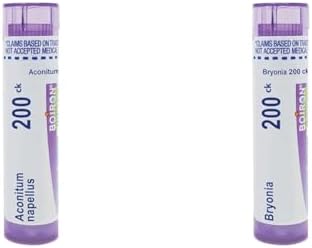
Aconite 200C Homeopathic Remedy on Amazon
Aconite for Neuralgia & Pain
Aconite is indicated for sudden, violent, shooting pains — neuralgic pains that strike like lightning and vanish just as quickly. The best-known example is trigeminal neuralgia: paroxysms of intense, stabbing, electric-shock-like pain in the face, often triggered by cold air, a breeze, or the lightest touch. The pain is so violent that the patient is thrown into the characteristic Aconite state — restless, terrified, convinced something dreadful is happening.
Other pain presentations in the Aconite picture:
- Facial neuralgia — sudden, violent, shooting pain in the face, often after cold exposure
- Toothache with extreme sensitivity to cold air, coming on suddenly
- Numbness and tingling of the face, lips, or extremities accompanying the pain
- Earache in children that comes on rapidly after playing outdoors in cold, windy weather — the child inconsolable, restless, the ear hot and sensitive
- Eye pain from acute inflammation after cold, dry wind or dust — red, hot, burning eyes with light sensitivity
Aconitum Napellus Homeopathic Pellets on Amazon
Potency & Dosing (30C/200C Acute)
Choosing the right potency matters as much as choosing the right remedy. Here is a practical guide to the common potencies:
| Potency | Best For | How It Is Used |
|---|---|---|
| Q (Mother Tincture) | External applications for nerve pain; supportive use in chronic anxiety | A few drops diluted in water, or topically — professional supervision only; never self-prescribed |
| 30C | Acute emergencies — sudden fever, panic attacks, croup, first-stage cold | 3–5 pellets every 15–30 minutes in the acute phase; reduce frequency as symptoms improve |
| 200C | Intense or recurring acute states; strong emotional component | Once or twice daily during an acute episode; not to be repeated frequently |
| 1M (1000C) | Deep, chronic anxiety, PTSD, long-standing fear states | A single dose; repeat only under professional guidance, sometimes only once in weeks or months |
200C acts more deeply and is chosen when symptoms are intense, recurring, or carry a strong emotional component — recurrent panic attacks, high fevers with great restlessness, or intense fear of death. It is best used sparingly — once or twice a day during an acute episode, ideally with a homeopath’s advice.
1M is a high-potency dose reserved for deeply chronic emotional states where the Aconite pattern is firmly established — chronic anxiety, PTSD, persistent fear of death after trauma. It is never self-prescribed; a professional consultation is mandatory.
A general rule for all potencies: Aconite acts best when given early, in the acute phase. Frequent repetition in chronic cases is not recommended without professional oversight.
Aconite 30C First-Aid Remedy on Amazon
When It Stops Fitting
Aconite is a remedy of the first hour, and its window of usefulness is narrow. Knowing when the case has moved beyond Aconite is as important as knowing when to give it. Watch for these signals:
- Sweating begins — dry, burning heat gives way to perspiration; the picture has shifted
- The fever has lasted more than 24 hours — Aconite’s window has passed
- The discharge thickens — a watery, burning nasal discharge turns yellow or green and the cold “settles in”
- The cough becomes productive — croupy barking gives way to rattling, mucusy coughing
- Panic gives way to exhaustion — the frantic, terrified patient becomes dull, heavy, and sleepy
- No response after 3–4 doses — the remedy is wrong or the moment has passed
Comparisons: Aconite vs. Belladonna, Arsenicum, Gelsemium & Opium
Aconite is frequently confused with other acute remedies. The table below shows the key differentiators:
| Remedy | Fever & Onset | Anxiety Style | Key Differentiating Feature |
|---|---|---|---|
| Aconite | Sudden, violent; dry burning heat; thirst for cold water | Terror, fear of death, frantic restlessness | Onset after cold dry wind or fright; better in open air; worse midnight |
| Belladonna | Sudden, very high fever; skin hot, red, dry | Delirium, confusion, staring eyes — less fear | Redness, throbbing, dilated pupils; worse from light, noise, touch |
| Arsenicum Album | Burning heat with chill; prostration; thirst for small sips | Extreme anxiety but with exhaustion and weakness | Burning pains better from heat; restless but weak; midnight aggravation; chilly |
| Gelsemium | Gradual onset; heavy, dull, sleepy; aching muscles | Anticipatory anxiety with trembling and weakness — no fear of death | Drowsiness, heaviness, drooping eyelids; slow onset; better from sweating |
| Opium | Fever with hot, flushed skin; stupor | Fearless or indifferent — the opposite of Aconite’s terror | Sleepiness, stupor, insensibility; suppressed pain; often after fright with paralysis of emotion |
Safety & Side Effects
The raw plant is toxic — the homeopathic preparation is not. This distinction is critical. *Aconitum napellus* in its natural form contains aconitine, one of the most poisonous plant substances in Europe; it must never be chewed, brewed as a tea, or handled carelessly. Homeopathic potencies (30C and above) contain no measurable plant material and are safe for all age groups when used appropriately.
Practical safety points:
- Mother tincture (Q): the undiluted alcoholic extract still contains active plant alkaloids. It is never for self-use — only a qualified practitioner should prescribe or apply it.
- Homeopathic aggravation: a brief, temporary worsening of symptoms may occur after the first dose, especially at 200C or 1M. It is typically short-lived and followed by improvement.
- Pregnancy: use Aconite with caution in pregnancy, particularly in the first trimester; consult a qualified practitioner first.
- Infants and newborns: safe at 30C under appropriate guidance; it is used in neonatal practice for fright after delivery and retention of urine.
- Emotional sensitivity: in emotionally vulnerable patients, high potencies can stir up deep fears. Use 200C and 1M with professional support in such cases.
- Antidotes: strong aromatics (camphor, coffee, mint) and excessive heat can antidote Aconite. Avoid them around the time of dosing.
FAQ
Q: Is Aconitum napellus safe to take? Yes — in homeopathic potencies (30C and above) it is safe for all ages when used appropriately. Only the mother tincture (Q) requires professional supervision.
Q: How quickly does Aconite 30C work? In acute conditions, Aconite 30C can produce noticeable results within 15–30 minutes. If there is no improvement after 3–4 doses, stop and reconsider — the remedy or the timing is wrong.
Q: Can I take Aconite for chronic anxiety? Aconite helps anxiety rooted in a specific traumatic event or shock, especially in the acute aftermath. For generalized chronic anxiety, a constitutional assessment by a qualified homeopath is recommended.
Q: What is the difference between 30C and 200C? 30C is the everyday acute potency — gentle, fast-acting, repeatable every 15–30 minutes in emergencies. 200C acts more deeply and is reserved for intense, recurring, or emotionally charged states; it is repeated far less often.
Q: Can Aconite be given to children? Yes. Children’s acute illnesses frequently match the Aconite picture — sudden fever, croup, earache after cold wind, fright. For pediatric use, 30C in small, frequent doses is standard, stopped as soon as improvement begins.
Q: What antidotes Aconitum napellus? Strong aromatic substances (camphor, coffee, mint), excessive heat, and certain other homeopathic remedies can antidote Aconite. Avoid these near the time of taking the remedy.
Q: Is Aconitum the same as Aconite? Yes. Aconite, Aconitum, *Aconitum napellus*, Monkshood, and Wolfsbane all refer to the same plant and the same homeopathic remedy.
Q: Do I need a prescription to buy Aconite? In most countries, homeopathic Aconite in low and medium potencies (30C, 200C) is available over the counter. High potencies such as 1M are best left to a qualified homeopath.
Conclusion
*Aconitum napellus* is a remedy of extraordinary power and speed — perfectly suited to the sudden, violent, fear-laden acute conditions of modern life. From the midnight croup attack of a frightened child to the panic of an adult convinced they are dying, Aconite brings rapid, gentle relief when matched correctly to the symptom picture: sudden onset, intense fear, restless body, dry heat, and a cold, dry wind or shock as the trigger.
The key to its success lies in three principles: prescribe early, match the keynotes precisely, and stop once improvement begins. Used this way — at 30C for an acute emergency, or at 200C and 1M for deeper states under professional guidance — Aconitum napellus remains one of homeopathy’s most indispensable and brilliant healing tools.
*Disclaimer: This article is for educational purposes only and is not a substitute for professional medical advice, diagnosis, or treatment. Always consult a qualified healthcare provider before starting any treatment.*


One Comment