What People Actually Search For When They Look Up a Homeopathic Remedy: Bing Data 2026


Data study · Bing search data · November 2026
We analysed 53,456 Bing impressions and 8,641 clicks across 102 homeopathic remedies,
collected from two US-facing homeopathy sites over 15 months. The result is a map of which remedies
attract attention — and which ones attract attention but never get clicked.
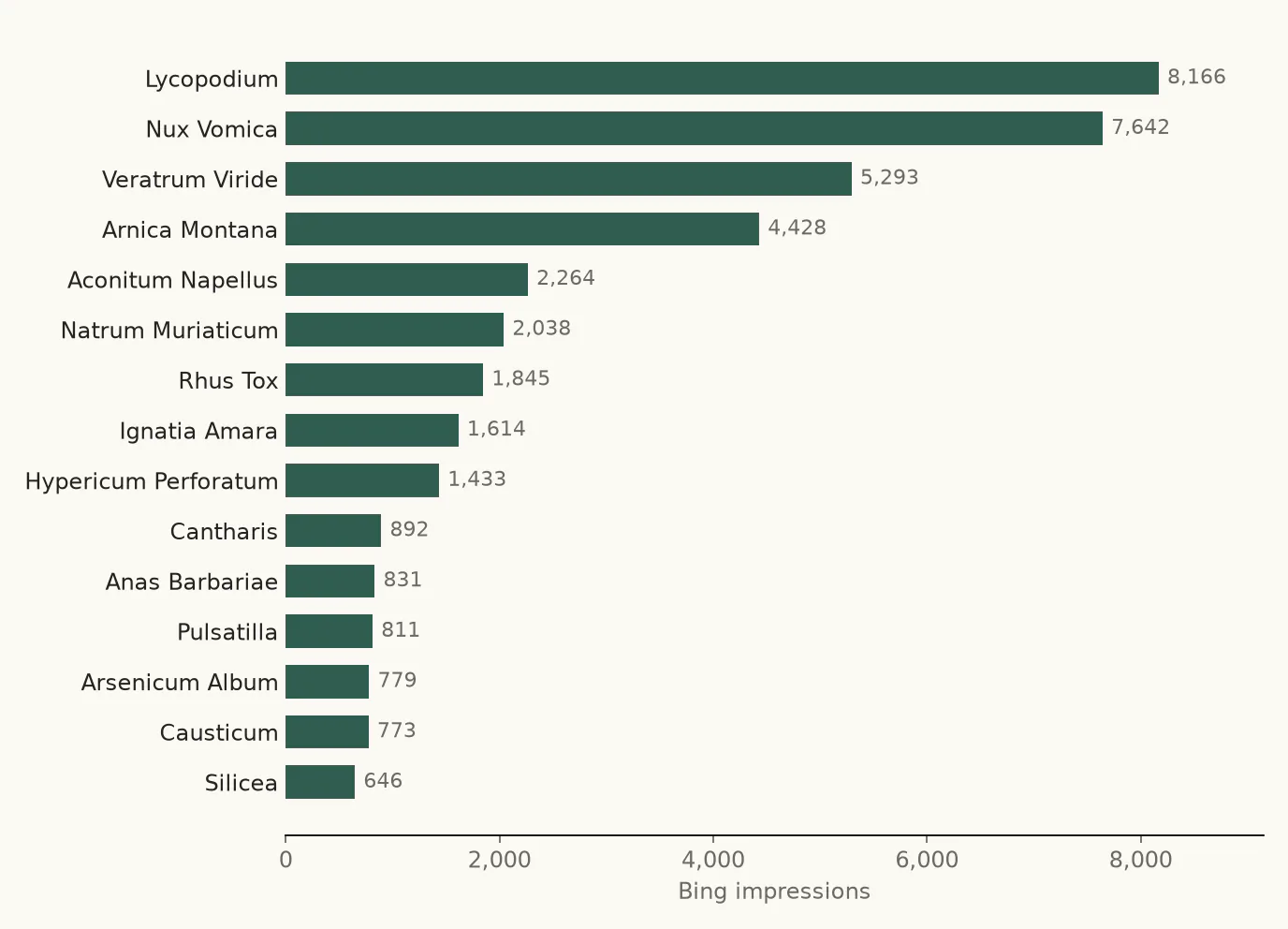
Which remedies dominate the demand
Two remedies account for 29.6% of every remedy impression in the dataset. Lycopodium and Nux Vomica are not
merely popular — they are in a different order of magnitude from everything below them.
| Remedy | Impressions | Clicks | CTR | Avg position | Query variants | |
|---|---|---|---|---|---|---|
| 1 | Lycopodium | 8,166 | 393 | 4.8% | 3.1 | 72 |
| 2 | Nux Vomica | 7,642 | 651 | 8.5% | 2.9 | 100 |
| 3 | Veratrum Viride | 5,293 | 50 | 0.9% | 4.8 | 9 |
| 4 | Arnica Montana | 4,428 | 259 | 5.8% | 3.9 | 91 |
| 5 | Aconitum Napellus | 2,264 | 320 | 14.1% | 2.9 | 66 |
| 6 | Natrum Muriaticum | 2,038 | 437 | 21.4% | 3.0 | 68 |
| 7 | Rhus Tox | 1,845 | 248 | 13.4% | 4.0 | 63 |
| 8 | Ignatia Amara | 1,614 | 332 | 20.6% | 3.5 | 54 |
| 9 | Hypericum Perforatum | 1,433 | 116 | 8.1% | 2.8 | 46 |
| 10 | Cantharis | 892 | 270 | 30.3% | 2.3 | 45 |
| 11 | Anas Barbariae | 831 | 109 | 13.1% | 3.8 | 12 |
| 12 | Pulsatilla | 811 | 222 | 27.4% | 4.0 | 86 |
| 13 | Arsenicum Album | 779 | 196 | 25.2% | 3.1 | 44 |
| 14 | Causticum | 773 | 247 | 32.0% | 3.1 | 47 |
| 15 | Silicea | 646 | 172 | 26.6% | 3.1 | 60 |
| 16 | Conium Maculatum | 626 | 130 | 20.8% | 3.3 | 47 |
| 17 | Berberis Vulgaris | 595 | 133 | 22.4% | 3.5 | 35 |
| 18 | Argentum Nitricum | 557 | 125 | 22.4% | 2.9 | 31 |
| 19 | Staphysagria | 515 | 167 | 32.4% | 2.9 | 37 |
| 20 | Apis Mellifica | 503 | 138 | 27.4% | 2.6 | 34 |
| 21 | Calcarea Carbonica | 477 | 104 | 21.8% | 3.8 | 37 |
| 22 | Allium Cepa | 475 | 22 | 4.6% | 4.4 | 7 |
| 23 | Chelidonium Majus | 444 | 98 | 22.1% | 3.3 | 34 |
| 24 | Gelsemium | 402 | 119 | 29.6% | 3.1 | 38 |
| 25 | Lachesis | 400 | 92 | 23.0% | 3.1 | 22 |
CTR here is clicks divided by impressions on Bing. Average position is Bing’s impression-weighted position.
The demand is steady, not spiking
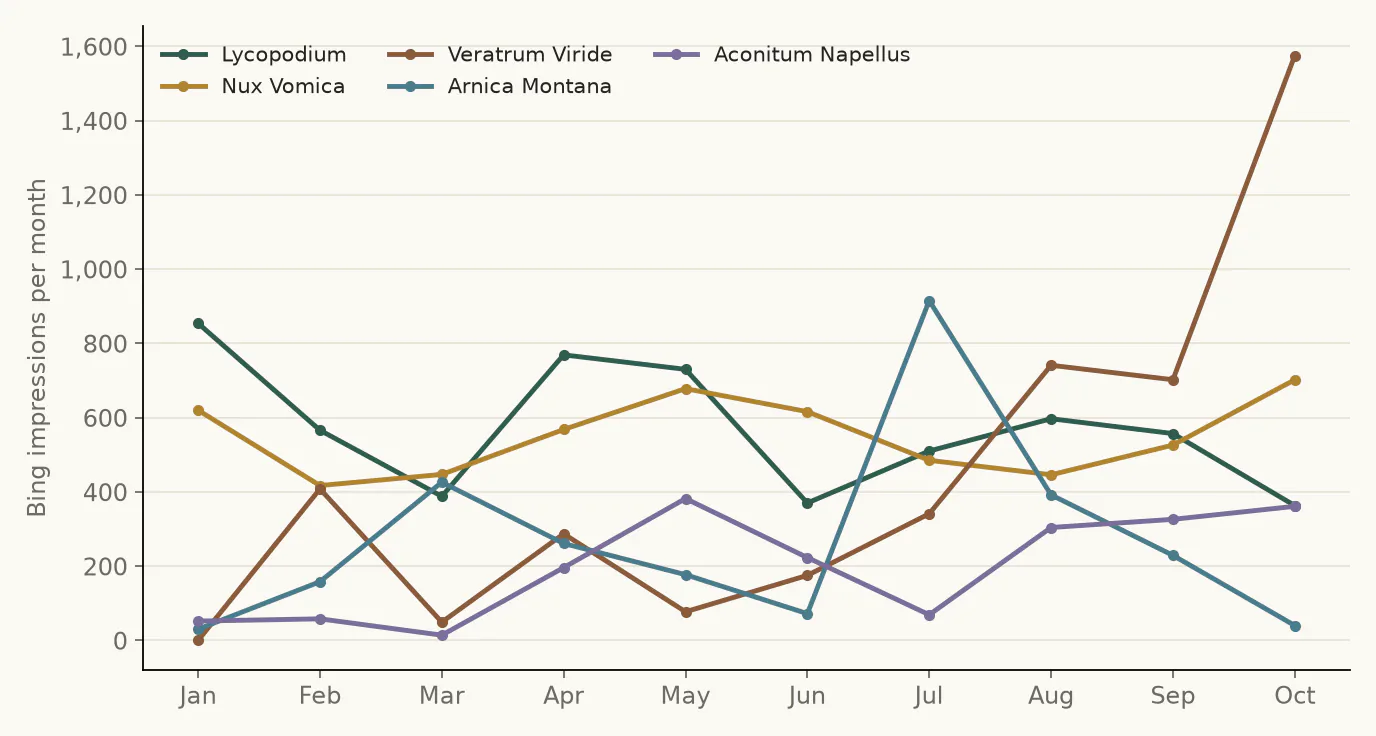
Monthly impression volume for the five largest remedies shows no dramatic seasonality — the pattern is a
broad, persistent interest rather than a short-lived trend.
The gap: high impressions, almost no clicks
The most striking finding is not which remedy is searched most, but how differently searchers behave once they
see a result. Average positions are broadly similar — between 2.3 and 4.8 — yet click-through rates range
from under 1% to over 30%.
Veratrum Viride is the clearest case: 5,293 impressions at an average position of
4.8 produced just 50 clicks — a 0.9% CTR. At the same time
Causticum converts 32.0% at position
3.1, and Staphysagria
32.4% at position
2.9.
Veratrum Viride is also the fastest-growing remedy in the dataset, and its growth is steady rather than a single
spike: 77 impressions in May, 175 in June, 341 in July, 741 in August, 702 in September, 1,575 in October —
roughly doubling every two months, with one flat month in September. Click-through never rose above 1%. That is not a ranking problem —
the page is already on the first page of results. It is a listing problem.
That spread is too large to be explained by ranking. It points at the listing itself — the title, the
description, and whether the snippet answers the question the searcher typed.
Potency-qualified searches convert far better
Queries that name a potency convert at 51.6% across 4,211 impressions,
against 13.1% across 49,245 for bare remedy names. The gap holds after
allowing for position: potency queries average 2.5, bare names 3.4.
People who already know which potency they want are looking for a specific answer, and they click when they
find it. Bare remedy names attract browsers.
Remedies gaining ground
Comparing May–July 2026 with August–October 2026, these remedies grew fastest among those with at
least 150 impressions in each window.
| Remedy | May–Jul | Aug–Oct | Change |
|---|---|---|---|
| Veratrum Viride | 593 | 3,018 | +408.9% |
| Aconitum Napellus | 674 | 991 | +47.0% |
| Causticum | 150 | 168 | +12.0% |
| Lycopodium | 1,610 | 1,517 | -5.8% |
| Nux Vomica | 1,779 | 1,674 | -5.9% |
| Ignatia Amara | 407 | 277 | -31.9% |
| Rhus Tox | 528 | 325 | -38.4% |
| Arnica Montana | 1,164 | 661 | -43.2% |
What this means if you publish homeopathy content
- Write for the remedy people already search, not the one you find interesting. The top five remedies
carry most of the demand; a long tail of 90+ others splits the remainder. - The headline is not the bottleneck — the snippet is. Positions of 3–4 producing 1% CTR is a
presentation failure, not a ranking failure. - Answer potency questions explicitly. Queries naming a potency convert 3.9×
better than bare remedy names (51.6% against 13.1%). If your page does not state 30C, 200C and 1M clearly, you are invisible to that traffic. - Expect steady, not viral. Remedy demand is flat month to month. Growth comes from covering more
queries, not from catching a wave.
these two sites on queries where their pages appeared. They are a proxy for relative interest among
people who encounter homeopathy content in Bing results — not total US search volume, and not a census of
all homeopathy searches. Bing’s export returns the top 100 queries per week per site, so absolute totals are a
floor rather than a complete count. Comparisons between remedies within this dataset are meaningful;
extrapolations to the whole market are not.
Method
Query-level performance was exported from Bing Webmaster Tools for two verified properties
(homeopathinfo.com and homeopathywatch.com) covering 68 weekly buckets. Every query was normalised to a canonical
remedy name: potency suffixes (30, 200, 1M, Q, 6C), misspellings and word-order variants were merged, so
“nux vomica”, “nux vomica 30” and “nux vomica 200” all count toward Nux Vomica.
Queries that name a condition rather than a remedy (“homeopathy for anxiety”) and generic head terms
(“homeopathy”) were analysed separately and excluded from the remedy ranking. CTR is clicks divided by
impressions. Average position is impression-weighted, as reported by Bing.
“What People Actually Search For When They Look Up a Homeopathic Remedy: Bing Data 2026.”
homeopathinfo.com, 23 November 2026.
Dataset: 102 remedies, 53,456 impressions, 8,641 clicks